


International Freight Management: Strategy, Compliance and Cost-Effective Global Shipping
International Freight Management: A Practical Guide for Modern Supply Chains
International freight management has shifted from a back-office function to a core business capability. Rising freight rates, volatile capacity, stricter customs controls, and rapid e-commerce growth mean shippers need more than a booking service—they need a structured approach to planning and managing global transport.
This guide covers what international freight management involves, how the market is changing, and how to build a cost-efficient, resilient freight strategy. It’s written for importers, exporters, manufacturers, and online brands that rely on global supply chains.
What is international freight management?
International freight management is the planning, execution, and optimization of moving goods across borders using multiple transport modes and partners while meeting time, cost, and compliance requirements.
It typically includes:
- Route and mode planning (sea, air, rail, road, multimodal)
- Carrier and forwarder selection and negotiation
- Booking, consolidation, and scheduling
- Customs clearance and trade compliance
- Documentation (commercial invoices, packing lists, bills of lading, certificates of origin)
- Freight cost control, surcharge management, and invoice auditing
- Cargo insurance and risk management
- Tracking, exception handling, and performance analysis
Effective freight management connects procurement, inventory planning, logistics, and customer service. For many companies, this is handled in close collaboration with a logistics partner that can coordinate services at origin and destination.
Why international freight management matters now
1. Volatile freight rates and capacity
Global freight markets have swung sharply since 2020. Ocean rates on key trade lanes like Asia-Europe and Trans-Pacific have moved in response to demand spikes, port congestion, and route disruptions. Capacity constraints, blank sailings, and equipment imbalances create ongoing uncertainty. Air freight remains sensitive to fuel prices and the availability of cargo space in passenger aircraft.
Shippers that actively manage contracts, spot bookings, and routing options control landed costs and avoid last-minute premiums.
2. Tightening trade and customs compliance
Governments are tightening customs and security rules:
- Stricter advance cargo information and security filings
- More detailed product classification and valuation checks
- Sanctions and export controls targeting specific countries, entities, or goods
- Sustainability and due-diligence regulations affecting sourcing and transport choices
Poorly managed documentation or misclassified goods can lead to delays, penalties, and cargo holds. Professional freight management ensures documentation, HS codes, and duties are handled correctly.
3. Growth of cross-border e-commerce
Cross-border e-commerce grows faster than traditional retail, creating two consequences: more small, frequent shipments alongside full-container loads, and higher customer expectations for delivery transparency and speed.
Many companies now blend parcel networks, international express, and freight forwarding to serve different markets and service levels. This requires a coherent international freight management strategy.
4. Pressure to increase supply chain resilience
Recent years have highlighted supply chain vulnerabilities: port strikes, geopolitical tensions, pandemics, and extreme weather. Companies are diversifying sourcing and production, which often means more countries and more complex freight networks. International freight management keeps these networks synchronized by rerouting shipments, adjusting modes, and keeping stakeholders informed when disruptions occur.
Core components of international freight management
Strategic planning and network design
Effective freight management starts with understanding your trade lanes and service requirements.
Key steps:
- Map export and import flows by origin, destination, volume, and product type.
- Define service priorities by lane (speed vs. cost vs. reliability).
- Identify hub locations and consolidation points like key ports or gateway airports.
- Decide where to hold inventory to balance lead times and working capital.
Companies with high shipment volumes often use long-term carrier contracts for base volume and spot market bookings for overflow. Smaller shippers may rely more on freight forwarders to aggregate volume and secure competitive rates.
Mode selection: air, sea, rail, or road?
Mode selection is central to international freight management. Each mode has trade-offs.
Sea freight
Best for high-volume, lower-value, less time-sensitive cargo.
Pros: Lowest cost per unit, high capacity, suitable for full-container loads (FCL) and less-than-container loads (LCL).
Cons: Longer transit times, port congestion risk, schedule variability.
Air freight
Best for high-value, time-critical, seasonal, or fragile goods.
Pros: Fast transit, lower risk of theft or damage, better schedule reliability.
Cons: Highest cost per kilo, capacity constraints in peak seasons, higher environmental impact.
Rail and multimodal
Best for Asia-Europe land routes and intra-continental moves where speed and cost must be balanced.
Pros: Faster than ocean on some lanes, lower emissions than air, relatively stable schedules.
Cons: Limited coverage, political and geopolitical risks on some corridors.
International road freight
Best for regional cross-border trade like intra-EU, US-Canada-Mexico, or intra-ASEAN moves.
Pros: Door-to-door capability, flexible routing, suitable for partial loads (LTL).
Cons: Border delays possible, driver and regulatory constraints.
In practice, many shippers adopt multimodal solutions such as combining sea freight with trucking and distribution at destination, or sea-air combinations on urgent lanes.
Freight forwarders and 3PLs in international freight management
Role of freight forwarders
Freight forwarders act as intermediaries between shippers and carriers, consolidating cargo and handling documentation, bookings, and coordination.
Common services include:
- Negotiating space and rates with carriers
- Consolidating LCL shipments into FCL where possible
- Preparing and checking transport and customs documents
- Coordinating origin pickup and destination delivery
- Providing online tracking and shipment visibility
Using a forwarder is especially valuable for small and mid-sized shippers that lack in-house freight procurement expertise or volume leverage.
When to work with a specialized logistics partner
You likely benefit from a specialist partner in international freight management if you manage multiple trade lanes and transport modes, ship both bulk cargo and e-commerce orders, frequently encounter customs issues or shipment delays, or need consolidated reporting on freight cost and performance.
A capable partner will not only execute bookings but also recommend optimized routes and modes, consolidate shipments to reduce cost per unit, monitor market conditions to adjust strategy, and support compliance and documentation to reduce delays.
Documentation and customs compliance
Essential documents in international freight
Accurate, complete documentation is the backbone of international freight management. Typical documents include:
- Commercial Invoice: Specifies seller, buyer, goods description, value, and payment terms.
- Packing List: Details packaging, weight, dimensions, and container packing.
- Bill of Lading (B/L) or Air Waybill (AWB): Contract of carriage and receipt issued by carrier.
- Certificate of Origin (CO): Confirms where goods were manufactured, used for duties and trade agreements.
- Insurance Certificate: Evidence of cargo insurance where applicable.
- Import/Export Licenses: Required for controlled goods in some countries.
Errors or inconsistencies between these documents can trigger customs inspections and delays.
HS classification, duties, and taxes
Correctly classifying goods under Harmonized System (HS) codes is critical. HS codes determine duty rates, import restrictions, and statistical reporting. Misclassification can lead to underpaid or overpaid duties, fines, and retroactive assessments.
International freight management involves maintaining a centralized HS code database for all products, reviewing product descriptions and technical specifications, and monitoring regulatory changes that impact classification or duty rates.
Modern customs trends
Recent customs trends affecting freight management include increased use of advance electronic declarations and risk assessment, greater data sharing between customs agencies for security and tax enforcement, implementation of trade facilitation measures for trusted traders like AEO and C-TPAT, and introduction of digital platforms for self-filing and automated clearance in some markets.
Shippers that invest in accurate master data and collaborate closely with customs brokers or freight partners can cut clearance times and reduce the risk of delays.
Cost control in international freight management
Understanding your total landed cost
Freight is only one component of total landed cost. To manage profit margins, consider base freight rates (by container, pallet, cubic meter, or kilo), surcharges (fuel, peak season, congestion, war risk, security), origin and destination charges (terminal handling, documentation, delivery), duties, taxes, and customs brokerage fees, and insurance and financing costs related to longer transit times.
A structured international freight management program focuses on total cost rather than only rate per container.
Strategies to reduce freight costs without sacrificing reliability
Practical strategies include:
Shipment consolidation: Combine small shipments into fewer, larger loads where possible. Move from LCL to FCL on high-volume lanes to reduce cost per unit.
Optimized packaging and cubic utilization: Redesign packaging to fit more units per pallet or per container. Use load planning tools to increase fill rates and reduce air shipped.
Balanced mode mix: Use air only where it adds real value like launches, urgent orders, or high-margin items. Shift regular replenishments to ocean or rail with better planning.
Tendering and carrier diversification: Run structured tenders to compare carriers and forwarders. Avoid dependence on a single carrier on critical lanes to retain negotiation leverage.
Accurate forecasting and longer lead times: Improve demand forecasting to allow more shipments via economical modes. Use consistent volumes to secure better contract terms.
Audit and visibility: Audit freight invoices to catch errors or unagreed surcharges. Use dashboard reporting to identify high-cost lanes and improvement opportunities.
Technology and data in international freight management
Digital tools transforming freight
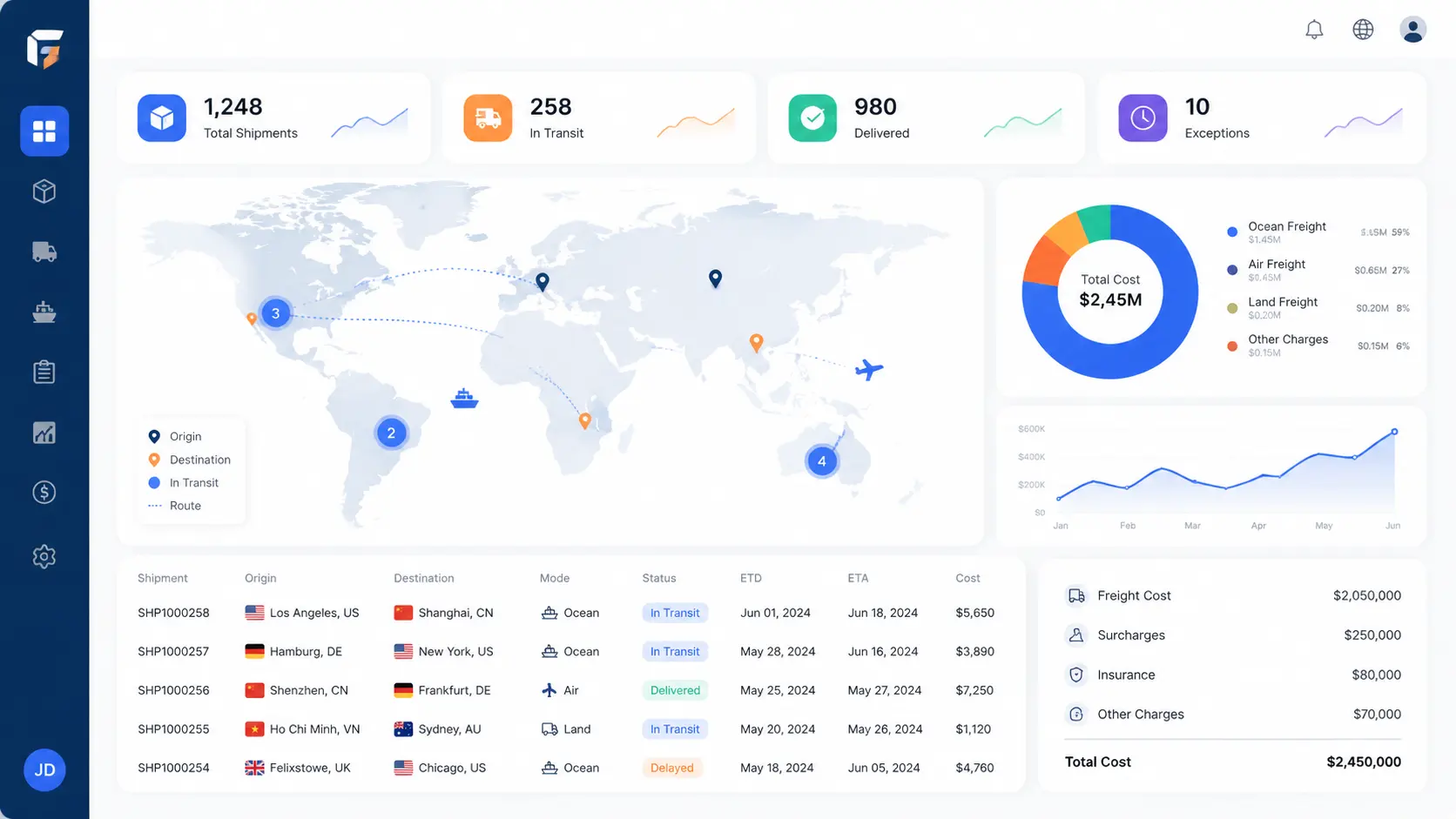
Modern international freight management relies increasingly on technology: Transportation Management Systems (TMS) for planning, booking, and tendering; freight visibility platforms providing real-time location and ETA updates; electronic document management for sharing invoices, B/Ls, and certificates; and analytics and BI tools for cost, performance, and carbon reporting.
These tools allow shippers and logistics partners to compare routes, modes, and carriers on cost and service, respond quickly to delays or disruptions, and measure KPIs such as on-time performance, damage rates, and cost per kilo or container.
Data quality and collaboration
Technology only delivers value if underlying data is high quality. Important practices include maintaining accurate product master data (weights, dimensions, HS codes), standardizing location names and codes across systems, aligning Incoterms and responsibilities between buyer and seller, and establishing shared KPIs with logistics partners and reviewing them regularly.
Collaboration is also key: integrating systems via APIs or EDI reduces manual data entry and errors, while shared visibility platforms keep all parties aligned.
Risk management and resilience
Identifying key freight risks
Principal risks in international freight management include schedule disruptions from port congestion, strikes, or weather; geopolitical events impacting specific routes or borders; currency volatility affecting freight rates and surcharges; damage, theft, or loss of cargo in transit; and regulatory changes that alter duties, taxes, or embargoes.
Building a resilient freight strategy
To increase resilience:
Diversify routes and modes: Avoid overreliance on a single port or corridor when alternatives exist.
Develop contingency plans: Predefine alternative carriers, ports, and modes for critical shipments.
Use appropriate cargo insurance: Ensure coverage matches cargo value, routes, and risk exposure.
Adjust safety stocks and lead times: Review buffer stocks in light of transit time variability and disruption risk.
Monitor market and regulatory changes: Regularly review updates from carriers, ports, customs authorities, and industry bodies.
International freight management for e-commerce and SMEs
Challenges for small and medium-sized businesses
SMEs and online sellers face distinct issues: lower volume makes it harder to negotiate competitive rates, limited in-house logistics expertise, high customer expectations for delivery speed and reliability, and cash-flow sensitivity to inventory and freight costs.
Practical approaches for smaller shippers
Partner with a forwarder experienced in e-commerce and small shipments: Use consolidation services, shared capacity, and simplified tariffs.
Standardize packaging and product data: This reduces mis-declarations and simplifies cross-border labeling.
Mix express and economy services: Offer premium delivery for urgent orders and economical options for price-sensitive customers.
Leverage fulfillment centers or bonded warehouses: Position inventory closer to key markets to reduce transit times and last-mile costs.

Key metrics to track in international freight management
To improve performance over time, track at least the following KPIs:
- On-time departure and arrival rate by lane and mode
- Average transit time and variability (standard deviation)
- Cost per kilo, per container, or per pallet by lane
- Freight cost as a percentage of sales or product value
- Damage or claim rate as a percentage of shipments
- Customs delay rate and reasons (documentation issues, inspections)
- Carrier and forwarder performance scores
Regularly reviewing these metrics with your logistics partner helps identify lanes where performance is trending down, opportunities to shift mode or carrier, and process changes needed to reduce delays or errors.
How to choose an international freight management partner
When selecting a logistics provider or freight forwarder, consider:
- Geographical coverage: Can they handle your current and planned trade lanes?
- Mode capabilities: Sea, air, road, rail, and multimodal solutions.
- Customs and compliance expertise: Knowledge of relevant markets and industries.
- Technology and visibility: Ability to provide tracking, reporting, and integration.
- Operational reliability: Track record on on-time performance and claims handling.
- Scalability: Ability to grow with your volumes and complexity.
Ask for references from companies with similar shipment profiles and confirm how they manage exceptions, communication, and after-sales support.
Action checklist: Improving your international freight management
To move from reactive to proactive freight management:
- Map your current international flows and major lanes.
- Classify shipments by urgency and value to choose appropriate modes.
- Review your Incoterms and responsibilities with suppliers and customers.
- Standardize product and packaging data to reduce customs and capacity issues.
- Implement or upgrade a TMS or visibility solution, or work with a partner that has one.
- Set clear KPIs and review performance with your logistics provider regularly.
- Develop contingency plans for critical lanes and high-risk regions.
- Audit freight invoices and surcharges against agreed terms.
Conclusion
International freight management is no longer just booking space on a ship or plane. It is a structured discipline that balances cost, speed, risk, and compliance across multiple modes and markets.
Companies that invest in better planning, reliable partners, and data-driven decision making can reduce total landed costs, improve delivery reliability and customer satisfaction, increase resilience against market disruptions, and support sustainable growth in global trade and e-commerce.
Whether you are a growing online brand or an established manufacturer, refining your approach to international freight management will directly support your commercial and operational goals.
Share:


